วันพุธที่ 11 กรกฎาคม พ.ศ. 2555

Assessment and Treatment of Muscle Imbalance:The Janda Approach

Assessment and Treatment of Muscle Imbalance:The Janda Approach Review


Assessment and Treatment of Muscle Imbalance:The Janda Approach


Assessment and Treatment of Muscle Imbalance:The Janda Approach Feature


  • in small improvements in performance.Part III, Intervention of Underrecovery,” focuses on the significance of correct competitive scheduling & training sequencing, which together underscore the processes leading to optimal performance. Emotional & mental factors in underrecovery & overtraining are also discussed.Part IV, Transfer to Related Areas,” examines the relationship between recovery & both physical & psychological health. The importance of attitudes, beliefs, & perceptions ar
  • e also addressed.Addressing recovery as a key factor of performance, the text illustrates how a constant lack of recovery can result in overtraining in athletes you work with. Further, it shows how being even slightly underrecovered over an extended period results in underperformance in athletes & nonathletes alike. Enhancing Recovery: Preventing Underperformance in Athletes is a critical resource for anyone researching or practicing in the exercise science field.author: Page, Phillip Pages: 312
  • SHK01513


Assessment and Treatment of Muscle Imbalance: The Janda Approach blends postural techniques, neurology, and functional capabilities in order to alleviate chronic musculoskeletal pain and promote greater functionality. Developed by Vladimir Janda, respected neurologist and physiotherapist , the Janda approach presents a unique perspective to rehabilitation. In contrast to a more traditional structural view, the Janda approach is functional—emphasizing the importance of the sensorimotor system in controlling movement and chronic musculoskeletal pain syndromes from sports and general activities. Assessment and Treatment of Muscle Imbalance: The Janda Approach is the only text to offer practical, evidence-based application of Janda’s theories.


Filled with illustrations, photos, and step-by-step instructions, Assessment and Treatment of Muscle Imbalance uses a systematic approach in presenting information that can be used in tandem with other clinical techniques. This resource for practitioners features the following tools:

--A rationale for rehabilitation of the musculoskeletal sytem based on the relationship between the central nervous system and the motor system --A systematic method for the functional examination of the muscular system --Treatment processes focusing on the triad of normalization of peripheral structures, restoration of muscle balance, and facilitation of afferent systems and sensorimotor training --The role of muscle imbalance and functional pathology of sensorimotor systems for specific pain complaints, including cervical pain syndrome, upper- and lower-extremity pain syndromes, and low back pain syndromes


Assessment and Treatment of Muscle Imbalance provides an evidence-based explanation of muscle imbalance. The step-by-step Janda system of evaluation is explained—including analysis of posture, balance, and gait; evaluation of movement patterns; testing of muscle length; and assessment of the soft tissue. The text explores treatment options for muscle imbalance through facilitation and inhibition techniques and sensorimotor training to restore neuromsucular function. It also includes four case studies examining musculoskeletal conditions and showing how the Janda approach compares with other treatments. This text combines theory, evidence, and applications to assist clinicians in implementing the Janda approach into their practice.


Assessment and Treatment of Muscle Imbalance: The Janda Approach focuses on the neurological aspects of muscle imbalance that are common causes of pain and dysfunction in sports and occupational activities. By distilling the scientific works of Vladimir Janda into a practical, systematic approach, this unique resource will assist health care providers in treating patients with musculoskeletal complaints as well as exercise professionals in developing appropriate exercise prescription and training programs.


วันอังคารที่ 10 กรกฎาคม พ.ศ. 2555

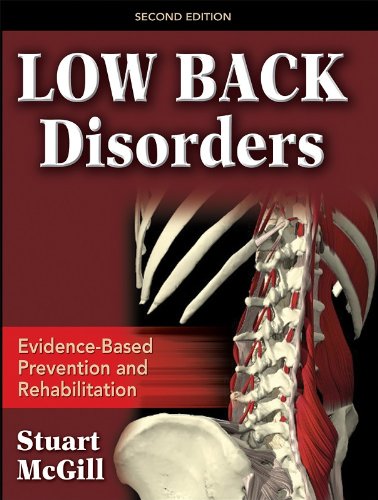
Low Back Disorders, Second Edition

Low Back Disorders, Second Edition Review


Low Back Disorders, Second Edition


Low Back Disorders, Second Edition Feature


  • Author(s): Stuart Mcgill
  • Published: 8-13-2007
  • SHK00903


Access the latest research and applications to build effective prevention and rehabilitation programs for your patients or clients with Low Back Disorders: Evidence-Based Prevention and Rehabilitation, Second Edition. Internationally recognized low back specialist Stuart McGill presents original research to quantify the forces that specific movements and exercises impose on the low back, dispels myths regarding spine stabilization exercises, and suggests prevention approaches and strategies to offset injuries and restore function.

Low Back Disorders: Evidence-Based Prevention and Rehabilitation, Second Edition,
presents a clear exposition of back anatomy and biomechanics and demonstrates how to interpret the latest research on low back involvement for clinical applications. The text also contains detailed information on injuries associated with seated work and sport and ergonomic issues related to manual handling of materials. With Low Back Disorders: Evidence-Based Prevention and Rehabilitation, Second Edition, you will

-gain valuable information on measured loading of the back during specific activities and apply it to avoid common—but counterproductive—practices in back rehabilitation;

-learn how to analyze each patient's or client's unique physical characteristics and lifestyle factors to tailor preventive measures and treatments to individual needs;

-learn how to help patients and clients progress through the stages of rehabilitation: corrective exercise, stability or mobility, endurance, and strength; and

-acquire the information necessary to design an effective injury-prevention program.
This fully updated second edition expands knowledge of low back disorders and best practices in several areas. Enhanced algorithms guide progessive therapeutic exercise, and specially designed patient assessment provocation tests aid you in determining the cause of back troubles, guide your choices in the best ways to eliminate problems, and improve the development of appropriate activities for functional gain. Whereas the first edition focused on increasing spine stability, the second edition provides new information on dealing with both regional instability or mobility and regional stiffness present in individuals where most of the motion occurs at a single spinal segment.

With an expanded repertoire of pain-free motion exercises and additional information on ways to find and adjust stabilization exercises, Low Back Disorders: Evidence-Based Prevention and Rehabilitation, Second Edition, offers you new tools to help your patients and clients achieve pain-free exertion.

The text includes exercises and activities that provide a solid foundation of physical work in preparation for more advanced activities in sports and occupations. Also, the process of transitioning into performance exercise is outlined with an explanation of the critical stages of the performance pyramid, including the design of appropriate corrective exercise, building joint and whole-body stability, enhancing endurance, training true strength, and transitioning to ultimate performance.

Low Back Disorders: Evidence-Based Prevention and Rehabilitation, Second Edition,
presents foundational information and corresponding clinical applications in a clear, well-sequenced format. Part I builds your knowledge of lumbar function and injury. Part II demonstrates how to use this knowledge to build evidence-based injury-prevention programs by assessing risks, creating ergonomic interventions, and training personnel. Part III focuses on improving rehabilitation techniques, including specific diagnostic and provocative tests, with specific therapeutic exercises proven to enhance performance and reduce pain through a continuum from corrective exercise to stability and mobility, endurance, strength, and power.

Additionally, the text offers these practical features to guide your learning and inform your practice:

-More than 475 photos, graphs, and charts support the research and the scientific basis for the text's conclusions.

-More than 50 tests and exercises with step-by-step instructions help you develop successful programs for your patients and clients.

-Special sections highlight how the anatomical, biomechanical, and research results can be applied to clinical situations.

-Extensive discussions on individualizing treatment for clients or patients help you improve your assessment skills by learning what questions to ask and what avenues of investigation to pursue with each patient or client.

-Reproducible handout sheets for each of the 25 basic rehabilitation exercises, which include photos and blank lines for instructions, enable the creation of instruction sheets tailored to the current needs and progress rates of each patient or client.
Cutting-edge research and evidence-based application strategies from the leading spine specialist in North America make Low Back Disorders: Evidence-Based Prevention and Rehabilitation, Second Edition, the authoritative text for study, care, and treatment of the low back. Its unique approach to back care will guide you in developing intervention, rehabilitation, and prevention programs to address the unique needs of each patient or client and develop a strong scientific foundation for your practice.


วันจันทร์ที่ 9 กรกฎาคม พ.ศ. 2555

How Real Is Real?

How Real Is Real? Review


How Real Is Real?


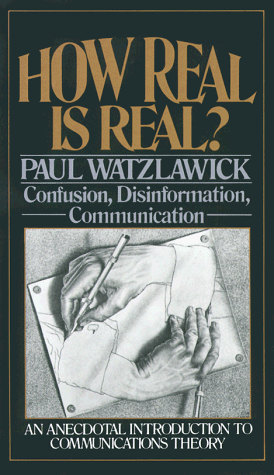
The connection between communication and reality is a relatively new idea. It is only in recent decades that the confusions, disorientations and very different world views that arise as a result of communication have become an independent field of research. One of the experts who has been working in this field is Dr. Paul Watzlawick, and he here presents, in a series of arresting and sometimes very funny examples, some of the findings.


วันอาทิตย์ที่ 8 กรกฎาคม พ.ศ. 2555

Neurology for the Non-Neurologist (Weiner, Neurology for the Non-Neurologist)

Neurology for the Non-Neurologist (Weiner, Neurology for the Non-Neurologist) Review


Neurology for the Non-Neurologist (Weiner, Neurology for the Non-Neurologist)


Neurology for the Non-Neurologist, Sixth Edition is a practical guide for primary care physicians, psychiatrists, and other non-neurologist clinicians who encounter patients with neurologic problems. The book begins with overviews of neurologic symptoms, the neurologic examination, diagnostic tests, and neuroradiology, and then covers the full range of neurologic disorders that non-neurologists encounter.

Chapters follow a consistent structure with key elements highlighted for quick scanning. Each chapter begins with Key Points and includes Special Clinical Points interspersed with the text to focus readers on the most crucial details. The authors alert readers to Special Considerations in the Hospitalized Patient and When a Non-neurologist Should Consider Referring to a Neurologist. Each chapter ends with an Always Remember section emphasizing the most important practical issues and a series of self-study questions.


วันศุกร์ที่ 6 กรกฎาคม พ.ศ. 2555

Peripheral Neurology: Case Studies

Peripheral Neurology: Case Studies Review


Peripheral Neurology: Case Studies


Peripheral Neurology was the first book to innovatively utilize case presentations as a vehicle to teach peripheral neurology. In fact, it was the first to categorize the field of peripheral neurology, as most other neurology texts concentrated on diseases of the central nervous system. This case approach has since been emulated in many other texts and on various web sites. Emphasizing the clinical condition rather than electrodiagnostic technique, each topic is thoroughly addressed, first in the Fundamental Concepts of Part I, and then in multiple Case Studies presented in Part II. The reader is able to simulate a true clinical environment where a diagnosis has to be arrived at with no organizational clues from the text. Formulating conclusions by analyzing the history, physical, and laboratory data, and linking from case to related case, this is the only text which allows this type of "interactive" reading. The book addresses many rare entities that the author is able to present based on his 30-years of experience.


วันพุธที่ 4 กรกฎาคม พ.ศ. 2555

EMG-Messungen bei Nervus Plexus Läsionen: Auswirkung einer Muskel-Sehnen-Transplantation (German Edition)

EMG-Messungen bei Nervus Plexus Läsionen: Auswirkung einer Muskel-Sehnen-Transplantation (German Edition) Review


EMG-Messungen bei Nervus Plexus Läsionen: Auswirkung einer Muskel-Sehnen-Transplantation (German Edition)


Jedes Jahr ereignen sich in Deutschland zwischen 1000 und 1500 Nervus Plexus Läsionen. Diese werden v.a. durch Motorradunfälle verursachte Traumata hervorgerufen. Die Auswirkungen sind oft schwerwiegend und reichen von Funktionsausfällen mehrerer Gelenke und sensiblen und motorischen Störungen bis hin zu vollständigen Lähmungen der betroffenen oberen Extremität. Die Therapie und Rehabilitation gestaltet sich langwierig und komplex. Zudem fehlt es sowohl seitens operativer als auch konservativer Therapien an einheitlichen Behandlungskonzepten. Darüber hinaus zeigt sich die Verlaufsbeobachtung nach erfolgter Intervention im klinischen und rehabilitativen Alltag sehr defizitär. In der vorliegenden Studie wird die Auswirkung einer Muskel-Sehnen-Transplantation bei einer Nervus Plexus Läsion untersucht und hinterfragt, inwieweit eine solche Transplantation die neuromuskuläre Ansteuerung des M. biceps brachii verbessert. Der Untersuchung dienen zwei Personen mit einer Nervus Plexus Läsion als Probandengut. Die eine Person wurde präoperativ, ohne sekundäre Ersatzoperation, die andere postoperativ, nach einem freien funktionellen Muskeltransfer des M. gracilis dexter als M. biceps-Ersatz untersucht. Als Untersuchungsverfahren wählte der Autor die Elektromyographie mittels Oberflächenelektroden. Die Messungen erfolgten standardisiert unter weitestgehender Einhaltung der Richtlinien der SENIAM group. Die ermittelten Werte wurden unter Betrachtung der Parameter maximale Amplitude, Integral, Root Mean Square und mittlere Amplitude verglichen. Zudem erfolgte eine Überprüfung auf Normalverteilung, Signifikanz und Reliabilität. Der Fokus der Studie liegt auf dem Vergleich von gesunder und betroffener Armseite - sowohl innerhalb als auch zwischen den Probanden.


วันอาทิตย์ที่ 1 กรกฎาคม พ.ศ. 2555

Electromyography and Neuromuscular Disorders: Clinical-Electrophysiologic Correlations, Textbook with CD-ROM

Electromyography and Neuromuscular Disorders: Clinical-Electrophysiologic Correlations, Textbook with CD-ROM Review


Electromyography and Neuromuscular Disorders: Clinical-Electrophysiologic Correlations, Textbook with CD-ROM


This New Edition delivers, in a straightforward manner, all of the information readers need to understand and interpret electrodiagnostic studies. It emphasizes clinical/neurophysiological correlations and uses a practical, hands-on, interactive approach throughout. With new chapters on electrical safety and the use of EMG in the ICU-and the inclusion of two bonus CDs with over 75 EMG waveforms-this resource continues to be the single source to consult for guidance on the clinical and electrophysiological evaluation of disorders of the peripheral nervous system.
  • Features case studies at the end of each chapter.
  • Provides a wealth of tables that summarize guidelines for the evaluation of most neuromuscular disorders as well as tables that highlight the results of nerve conduction studies and the electromyography for that particular patient.
  • Provides clear, original photographs that emphasize correct needle placement.
  • Delivers new chapters on electrical safety (including absolute and relative contraindications for EMG and NCS), the use of EMGs in the ICU, and basic statistics for electrodiagnostic studies
  • Includes new bonus CDs with over 70 waveforms, enabling readers to see and hear all of the waveforms discussed in the text.
  • Provides new discussions of pediatric EMG.
  • Discusses new disorders such as paralytic poliomyelitis caused by West Nile virus.